Debt can feel like a weight, holding you back from your goals. Whether it’s credit cards, student loans, or just random bills piling up, how you pay it down really changes how fast you can be free of it.
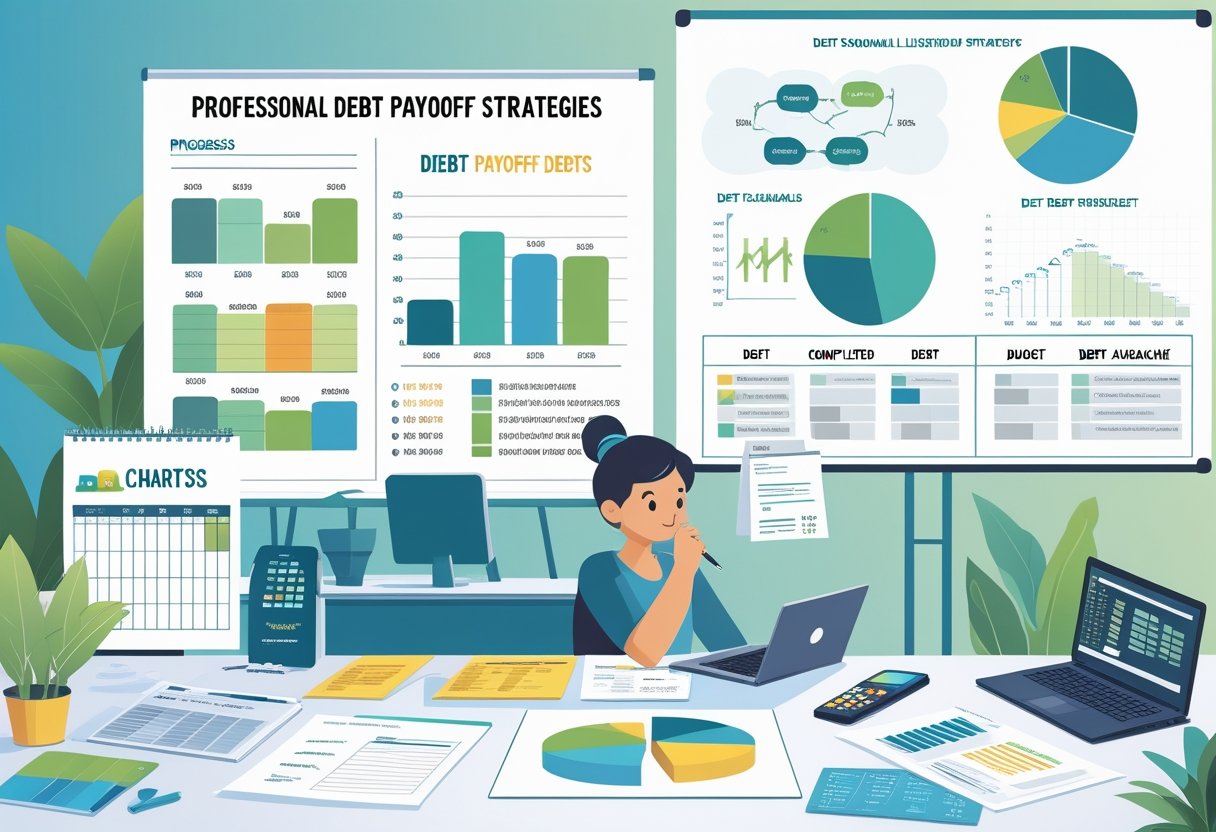
The most effective debt payoff strategies mix a clear repayment plan with real changes to your spending and income. Some folks go after their smallest debts first for those little wins, others attack high-interest ones to save more money in the long run.
Honestly, the best choice depends on your situation and what keeps you motivated. There’s no universal answer here.
Key Takeaways
- Start by reviewing all your debts and choosing a payoff method that matches your personality and financial situation
- Use strategies like the debt snowball or avalanche method along with tactics to reduce expenses and increase your income
- Maintain your debt-free status by building an emergency fund and developing smart money habits that prevent future debt
Assessing Your Debt Situation
Before you pick a debt payoff strategy, you’ve got to know what you owe. Getting a clear picture of your interest rates and debt compared to your income really helps you pick the right approach.
Taking a Complete Debt Inventory
Start by pulling your credit report from all three major bureaus. Sometimes there are debts you forgot about hiding in there.
Make a list of each debt with these details:
- Creditor name
- Total balance owed
- Minimum payment amount
- Interest rate
- Due date
Don’t just list credit cards—include student loans, car loans, personal loans, and even medical bills. Write down the current balance for each, not just the original amount.
Your debt inventory should also note which debts have the highest monthly payments. That matters if you need to free up cash quickly.
Understanding Interest Rates and Payment Terms
Interest rates are what really sting. A credit card at 24% racks up charges way faster than a car loan at 6%.
Check the interest rate on each loan. High-interest debt usually deserves your attention first.
Your minimum payment is the lowest you can pay each month without getting hit with fees. But only paying the minimum drags the debt out for years and costs you more in the end.
Some loans have variable rates, others are fixed. If you have variable rates, those payments could go up later—something to keep in mind.
Building a Debt Payoff Foundation
A solid budget is your game plan. It shows exactly how much you can put toward debt each month and helps you spot places to cut expenses.
Creating a Realistic Budget
Jot down your total monthly income after taxes. That’s the real number you have to work with.
List all your fixed expenses—rent, utilities, insurance, and minimum debt payments. Then add your variable costs like groceries, gas, and entertainment.
Subtract expenses from income to see your cash flow. If you’re spending more than you earn, it’s time to cut back. If you’ve got money left over, that can go straight to paying off debt.
A good budget to pay off debt usually looks something like this:
- Housing (30% or less)
- Transportation (15-20%)
- Food (10-15%)
- Debt payments (20% or more)
- Savings and everything else (what’s left)
Try a budget app like Mint, EveryDollar, or YNAB. They pull in your transactions and categorize them for you—makes life easier.
Tracking Spending and Cutting Expenses
Go through your last three months of bank and credit card statements. Write down everything you spent.
Most people are shocked at what they spend on restaurants, subscriptions, and random stuff. Here are a few places you can usually save:
- Cancel unused streaming services and gym memberships
- Cook at home more often
- Switch to a cheaper phone plan
- Buy store brands at the grocery store
- Lower your utility bills by tweaking the thermostat
Even $200 in monthly savings adds up to $2,400 a year you can use to reduce debt faster. Not bad, right?
Track every dollar for at least a month. Use a notebook, spreadsheet, or an app—whatever sticks. This habit helps you spot patterns and make smarter choices.
Setting Measurable Financial Goals
Set specific financial goals with numbers and deadlines. Instead of “pay off debt,” try “pay off $5,000 in credit card debt by December 2026.”
Break big goals into smaller monthly steps. For example, to pay off $12,000 in two years, you’ll need to put $500 extra toward debt each month.
Write down three debt goals:
- Short-term (1-3 months): Build a $500 emergency fund
- Medium-term (3-12 months): Pay off your smallest debt
- Long-term (1-3 years): Become debt-free
Sites like NerdWallet have calculators that show how long it’ll take at different payment amounts. Super helpful for setting timelines.
Check your progress every month. Life happens—adjust if your income drops or you get hit with an unexpected bill. The important thing is to keep aiming at something clear.
Core Debt Payoff Strategies
There are two main ways people tackle debt: paying off the smallest balances first for quick wins, or targeting high-interest rates to save more money. Either way, you’ll need to make extra payments beyond the minimums and focus your efforts in order.
Debt Snowball Method
The debt snowball method is all about momentum. You pay off your smallest debts first, while making minimum payments on the rest.
When you knock out the smallest one, roll that payment into the next smallest. It’s like a snowball getting bigger as it rolls downhill.
How to use the snowball method:
- List debts from smallest to largest balance
- Pay minimums on all except the smallest
- Throw all extra money at the smallest debt
- When it’s gone, move to the next one
This approach is great if you need those early wins to stay pumped up. People tend to stick with it more, even if it costs a bit more in interest over time.
Debt Avalanche Method
The debt avalanche goes after the highest interest rates first. Arrange your debts from highest to lowest rate, not by balance.
All your extra payments go to the high-interest debt, while you keep making minimums on the rest. Once that one’s gone, move down the list.
How to use the avalanche method:
- List debts by interest rate (highest to lowest)
- Make minimum payments on all
- Focus extra money on the highest-rate debt
- Move to the next one after payoff
This saves you the most money in the long run since you cut down expensive interest charges. The downside? It might take longer to get your first debt paid off, so it can feel like a slow start.
Advanced Repayment Tactics
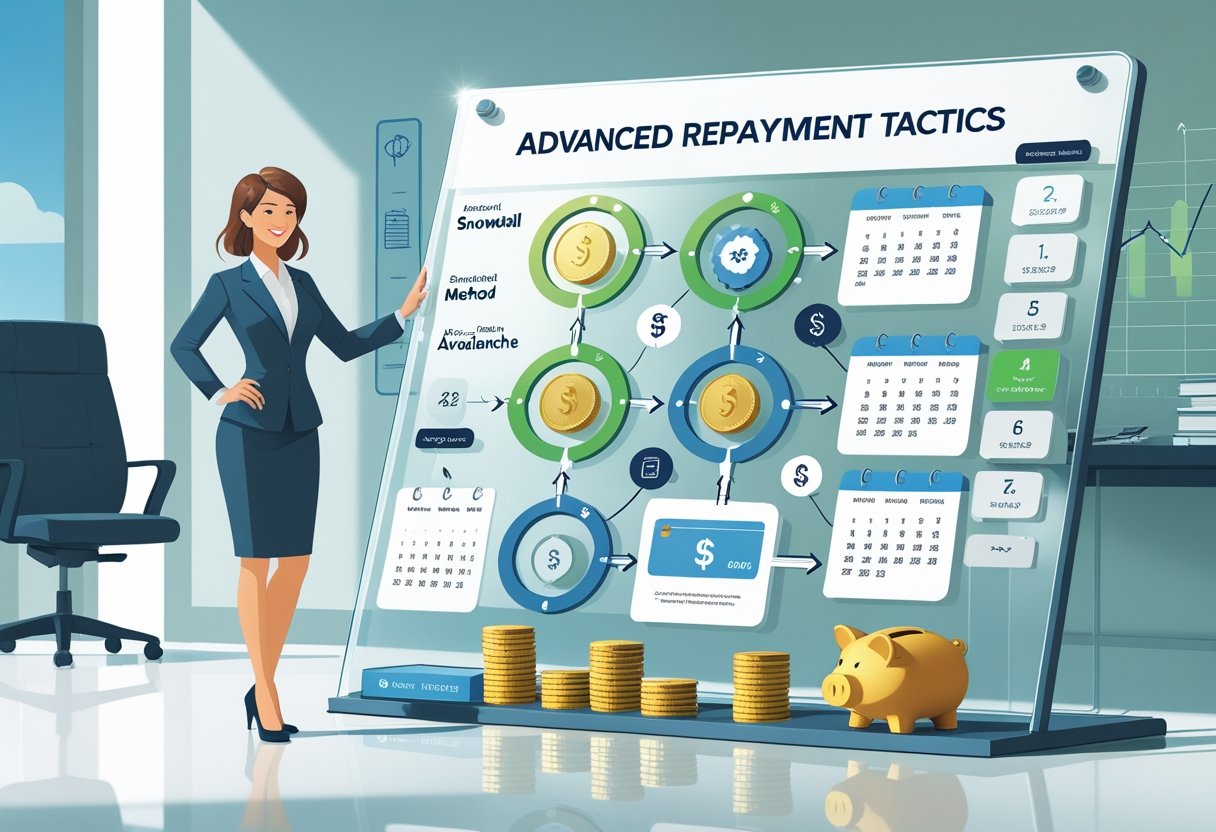
Once you’ve picked a method, a few extra tricks can help you pay off debt even faster. Automatic payments keep you from missing due dates, and splitting your monthly payment into smaller chunks can chip away at the principal more quickly.
Automating Payments and Staying Consistent
Automatic payments take the pressure off remembering due dates. You won’t risk late fees or a dinged credit score because the minimum gets paid, every time.
Set up autopay with your bank or creditors to make sure those payments always go through. This way, your payment history stays clean, and you can focus on other financial decisions instead.
Schedule extra payments automatically too. If you’re paid every two weeks, why not automate a transfer to your top-priority debt the day after payday?
Paying off debt this way means you don’t accidentally spend money meant for balances. It’s a sneaky but effective move.
Even with automation, check your debt milestones every month. Glance at your statements to make sure payments posted and watch your balances drop.
Bi-Weekly and Micro-Payment Strategies
Switching to bi-weekly payments can sneak in an extra full payment each year. Paying half your monthly amount every two weeks adds up to 26 half-payments—13 full ones instead of 12.
This strategy can cut interest and help you pay off debt faster. But check with your lender to be sure bi-weekly payments go straight to principal, not just held until the full amount arrives.
Micro-payments are another trick. Round up your purchases and toss the spare change at your debt. Even small windfalls or rebates—send them to your balances right away rather than letting them vanish into everyday spending.
Making More Than the Minimum Payment
Minimum payments mostly cover interest, so your balance barely budges. Add $25 or $50 extra each month and you’ll speed up debt payoff, saving hundreds or even thousands in interest.
Look at your budget and see what you can trim. Maybe skip a few subscriptions or eat out less, then send that money to your debt. Raises, tax refunds, or bonuses? Throw them at your balances instead of upgrading your lifestyle.
Focus extra payments on one debt at a time while keeping minimums on the rest. When you wipe out that first balance, roll its payment into your next target.
That momentum can really help you pay off debt fast. It’s almost addictive once you see the progress.
Debt Consolidation and Relief Options
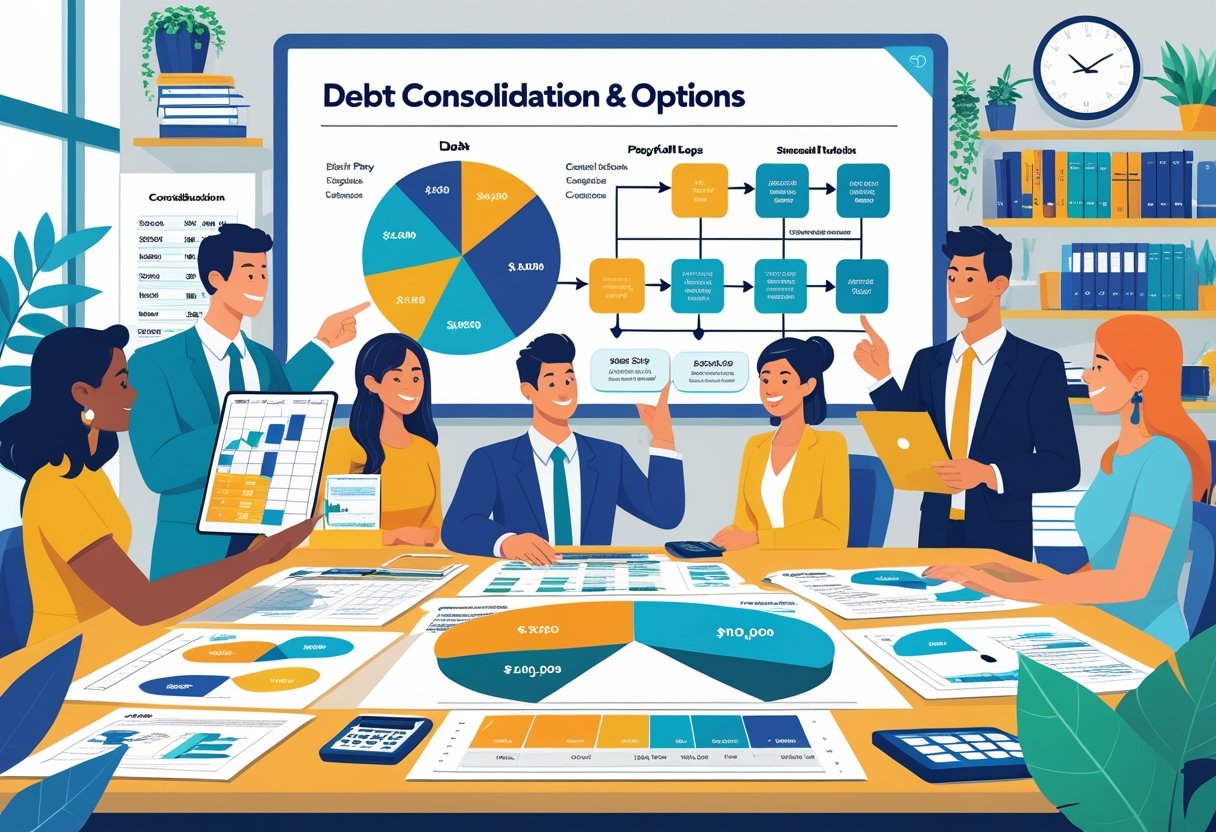
Combining multiple debts into one payment can make life simpler and sometimes lowers your interest rate. The best consolidation method depends on your credit, debt amount, and what you have to work with.
When to Consider Debt Settlement
Debt settlement means negotiating with creditors to pay less than you owe. Debt settlement services usually take 15-25% of your enrolled debt as fees.
This route will hit your credit hard. Late payments and settled accounts stick to your report for seven years, and you might owe taxes on forgiven amounts over $600.
Debt settlement is really for when you can’t afford even the minimums and want to avoid bankruptcy. Most programs want at least $7,500-10,000 in debt to make it worthwhile.
Accelerating Debt Payoff
Throwing extra money at debt can shave years off your timeline and save a ton in interest. Whether it’s side gigs, selling stuff, or using windfalls, it all adds up if you plan it out.
Increasing Income with Side Hustles
Side hustles are a classic way to boost your debt payoff. Freelance writing, rideshare driving, or delivering food—there are lots of options.
Online platforms make finding gigs easier than ever. Maybe you tutor, manage social media, or become a virtual assistant. Some jobs pay $15 to $50 an hour, depending on what you can do.
Pick something that fits your schedule and skills. Even $500 more each month means $6,000 a year toward debt. Look for opportunities that fit your lifestyle and don’t be afraid to try something new.
Start with one side job so you don’t burn out. Consistency over a few months can make a real dent in your balances.
Selling Unused Items and Extra Cash Strategies
Most of us have stuff lying around that’s worth real money—electronics, furniture, clothes, collectibles. Selling them can give you fast cash for debt payments.
Sites like Facebook Marketplace, eBay, and Poshmark make it simple. Snap good photos, write honest descriptions, and price things to move.
Go for the high-value items first. Old phones, tablets, gaming consoles, and tools often sell quickly. One sale could net you $200 to $500, easy.
Don’t ignore the small stuff, either. Books, appliances, and home décor can add up if you batch them. Maybe set aside a weekend each month to list things until your clutter (and debt) is gone.
Leveraging Windfalls Toward Debt
Tax refunds, bonuses, gifts, inheritances—these are your secret weapons for debt. The average tax refund in 2025 is about $3,000, enough to wipe out a few small debts or chunk down a big one.
Try to commit at least 80% of any windfall to debt before you get it. That way, you’re less tempted to splurge. If you land a $2,000 bonus, maybe $1,600 goes to debt and you keep $400 for a treat.
Plan for annual windfalls like tax season or holiday bonuses. Mark them on your calendar and figure out how far they’ll move the needle. A $5,000 tax refund on a credit card with 18% interest? That’s $900 saved in yearly interest.
Seeking Guidance and Professional Support
Sometimes, a little help from the pros makes all the difference. Credit counselors can review your finances for cheap—or free—while financial advisors help with bigger-picture money moves.
Debt Management Plans and Negotiating With Creditors
A debt management plan (DMP) means you make one payment to the agency, and they pay your creditors for you. It’s structured and predictable.
Your counselor negotiates with creditors to try to lower rates or waive fees. Many companies give better terms through a DMP than you’d get solo.
Professional advisors can help when you meet with creditors about payment options. Usually, you’ll close your credit cards when you start a DMP, but you might keep one for emergencies.
DMPs usually last three to five years, and you have to make payments on time or lose the benefits.
Deciding If You Need a Financial Advisor
Financial advisors go beyond debt—they help with retirement, investments, taxes, and building wealth overall.
You might want a financial advisor if your finances are complicated, you run a business, or have several goals at once. Fees vary a lot, from hourly to a cut of what they manage.
Meeting with a credit counselor or advisor helps you see all your options for ditching debt. A fee-only advisor is best—they don’t push products for commissions.
If debt is your main issue, start with a credit counselor. They’re cheaper and specialize in debt. You can always hire an advisor later if you need more help.
Maintaining Debt Freedom for the Long Term
Once you’re debt-free, keeping it that way means building safety nets and sticking to smart habits. An emergency fund keeps you from falling back into debt, and accountability helps you stay motivated.
Building an Emergency Fund
Start saving for emergencies as soon as you’re out of debt. Most experts say to aim for 3-6 months of living expenses in a separate savings account.
This fund keeps you from reaching for credit cards when life throws a curveball. Without it, even a car repair could put you right back in the hole.
Start with these steps:
- Figure out your monthly expenses—rent, utilities, food, insurance
- If six months feels impossible, shoot for $1,000 to start
- Set up automatic transfers of $50-100 per paycheck into your emergency fund
- Keep this money in a high-yield savings account for easy access
Your emergency fund also helps your credit by lowering the odds you’ll max out cards again. Stick with it, and your credit score should keep climbing as you stay debt-free.
Staying Accountable and Motivated
Find an accountability partner who understands your debt payoff plan and financial goals. This could be your spouse, a close friend, or maybe even a family member who checks in with you once a month about your spending and savings.
Track your progress using apps or a simple spreadsheet. Seeing how far you’ve come is a solid reminder of why you’re putting in the effort.
Set up accountability through:
- Monthly money meetings with your partner or trusted friend
- Budget apps that send spending alerts
- Joining online communities focused on financial freedom
- Celebrating milestones like reaching emergency fund goals
Review your debt payoff strategies regularly to make sure you’re still on track. Keep using the habits that helped you get out of debt, like sticking to your budget and avoiding impulse buys.
Frequently Asked Questions
The debt avalanche method saves the most money on interest for high-rate debts. If your income is limited, focus on minimum payments and trimming small expenses.
Each payoff strategy fits different situations, depending on your debt types, interest rates, and what actually keeps you motivated.
What is the most effective strategy for paying off high-interest debt?
The debt avalanche method prioritizes paying off debts with the highest interest rates first. You make minimum payments on everything else and put any extra money toward the debt with the highest rate.
This approach saves you the most money over time. High-interest debt above 10% APR adds up fast the longer it lingers.
Credit cards usually carry rates between 18% and 25%. Paying those off first keeps interest charges from snowballing out of control.
How can individuals with low incomes approach debt repayment efficiently?
Start by making all minimum payments to avoid late fees and credit dings. Missing payments can cost you $25 to $40 in fees and might even raise your interest rates.
Look for small ways to cut monthly expenses. Canceling unused subscriptions or eating out less by even $50 a month adds up to $600 a year for debt payments.
The debt snowball method is great if you’re working with a tight budget. Paying off your smallest debt first gives a quick win and frees up that minimum payment for the next one.
Consider reaching out to a non-profit credit counseling agency. They can sometimes negotiate lower interest rates with your creditors for a monthly fee, usually around $25 to $50.
What are the advantages and disadvantages of the debt snowball method?
The debt snowball method focuses on paying your smallest debts first, no matter the interest rate. This creates quick wins that keep you motivated.
You see results fast because small debts disappear in weeks or months. Each paid-off account builds confidence to take on bigger ones.
The main drawback? You pay more in total interest. Ignoring high-interest debts while tackling smaller ones means those bigger balances keep growing.
Still, a lot of people stick with the snowball method. The psychological boost from quick wins can outweigh the extra interest for many folks.
In what scenarios is the debt avalanche method preferred over other strategies?
The avalanche method shines when you have multiple debts with very different interest rates. If you’ve got a credit card at 24% APR and a car loan at 6%, attacking the card first saves you real money.
Pick this method if you’re motivated by numbers and logic. Watching your total interest charges drop can be pretty satisfying.
People with larger debts get the most out of the avalanche approach. The interest savings really add up if you owe $20,000 or more across several accounts.
This strategy also makes sense when your smallest debts have low or no interest. There’s not much point in paying off a $500 medical bill at 0% interest just to say it’s gone.
Can debt consolidation be beneficial for managing multiple debts, and how does it work?
Debt consolidation combines multiple debts into one loan with a single monthly payment. You basically take out a new loan to pay off everything else at once.
This works when you qualify for a lower interest rate than what you’re paying now. Personal loans usually range from 6% to 36% APR, while credit cards often charge 18% to 25%.
Balance transfer credit cards offer 0% APR for 12 to 21 months. You’ll pay a 3% to 5% transfer fee upfront, but if you pay off the balance during the promo period, you save a lot on interest.
Home equity loans come with rates between 3% and 7%, but your house is on the line if you can’t make payments. Only go this route if you’ve got a rock-solid plan.
The big benefit is simplicity. Managing one payment instead of five or six just makes life easier and lowers the odds of missing something.
What steps should someone take to pay off a significant amount of debt within a short time frame?
Start by listing all your debts. Write down the balances, interest rates, and minimum payments for each one.
It’s crucial to see the full picture before you try to tackle it—otherwise, you’re just guessing.
Cut your expenses as much as you can. For one month, track every dollar you spend and look for places to trim the fat.
Honestly, you might be surprised by how much leaks out here and there. Cancel unused subscriptions, cook at home, or put off big purchases.
Try to boost your income, too. Pick up a side gig, sell stuff you don’t need, or see if you can get some overtime hours at work.
Even a little extra money each week can make a real difference. It all adds up faster than you’d think.
Switch to bi-weekly payments instead of monthly. This sneaky trick means you end up making one extra payment a year, and it chips away at the interest.
It’s not magic, but it does help.
Pick a payoff strategy—either the avalanche or the snowball method. Stick to your choice instead of bouncing between them.
Both work if you’re consistent, so just pick the one that feels right for you.
Don’t be afraid to call your creditors and ask for a lower interest rate. If you’ve got a decent payment history, some credit card companies will knock off a few percentage points just because you asked.
It’s worth a shot, right?